Product comparisons
Isononanoic Acid vs. 2-Ethylhexanoic Acid: A Selection Guide
Compare INA and 2-EHA by identity, supplied-grade data, application fit, regulatory review, and the tests needed before substitution.
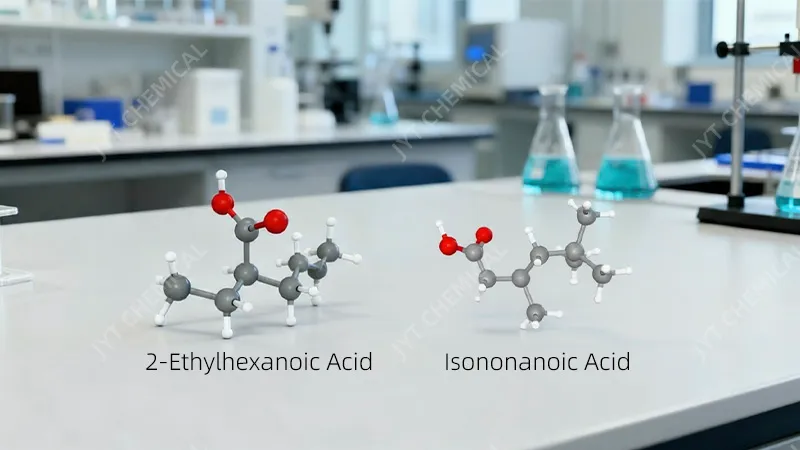
Isononanoic Acid (INA) and 2-Ethylhexanoic Acid (2-EHA) are branched carboxylic acids used in several overlapping industrial applications. They are still different raw materials. The practical choice depends on the reaction, the required properties of the derivative, the coating or fluid formulation, and the regulatory requirements for the destination market.
Identity and supplied-grade data
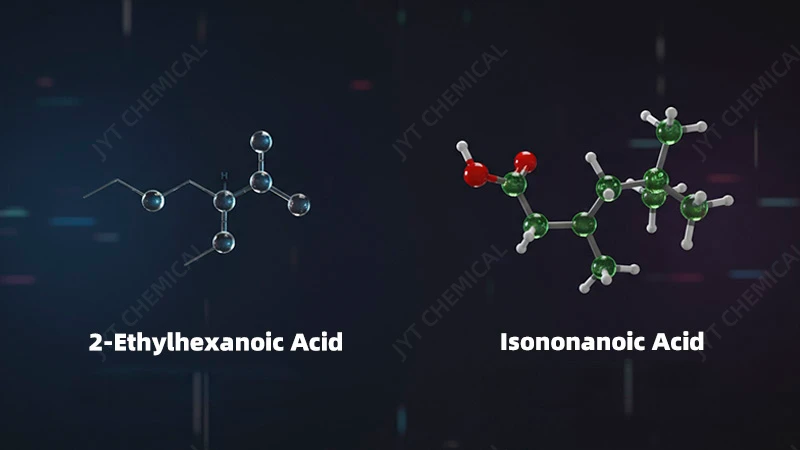
The current JYT product data identifies INA as 3,5,5-trimethylhexanoic acid, a branched C9 acid, and 2-EHA as a branched C8 acid. Their different identities change molecular weight and the typical values of the supplied grades.
| Item | Isononanoic Acid | 2-Ethylhexanoic Acid |
|---|---|---|
| CAS number | 3302-10-1 | 149-57-5 |
| Molecular formula | C9H18O2 | C8H16O2 |
| Molecular weight | 158.238 g/mol | 144.21 g/mol |
| Acid value | At least 350 mg KOH/g | At least 385 mg KOH/g |
| Purity | At least 99.5% | At least 99.5 wt% |
| Color | No more than 10 Pt/Co | No more than 10 Pt/Co |
| Moisture | No more than 0.1 wt% | No more than 0.1 wt% |
These are the current JYT grade values, not a universal specification for every material sold under either name. Use the relevant TDS and agreed sales specification when qualifying a supply.
The application ranges overlap, but not completely
Both acids are used as industrial intermediates in metal carboxylate and ester chemistry. The approved JYT application data provides a more useful starting point than a broad performance ranking.
| Selection area | INA | 2-EHA |
|---|---|---|
| Synthetic lubricant esters | Used in polyol ester lubricants | Used as an acid intermediate for synthetic lubricant esters |
| Metalworking and coolant systems | Used in lubricant and coolant corrosion-inhibitor systems | Used as an intermediate in lubricant and automotive-coolant systems |
| Coatings | Used in paint driers and alkyd resins | Used in metal carboxylates, paint driers, and coatings |
| Polymer additives | No approved PVC application stated for this grade | Used in PVC stabilizers |
| Other intermediates | Used for acid chlorides and cosmetic intermediates | Used in industrial intermediate applications |
The table describes where each product is currently positioned. It does not show equivalent dosage or confirm that a derivative made from one acid will match a derivative made from the other.
Selection for ester fluids starts with the derivative
The approved product data does not support a universal thermal-stability ranking for esters made from these acids. Finished ester performance depends on the acid, the alcohol or polyol, ester distribution, residual acidity, additives, and test conditions.
For a lubricant or metalworking-fluid project, compare the actual ester candidates. Useful screening data may include viscosity at the required temperatures, pour point, volatility, flash point, hydrolytic stability, oxidation response, corrosion behavior, elastomer compatibility, and deposit tendency. Choose the tests that match the equipment and service conditions. A molecular structure diagram cannot replace them.
The different molecular weights also matter in synthesis calculations. An equal mass of each acid does not provide an equal number of moles. Formulators should calculate stoichiometry from the approved assay and molecular weight, then check reaction completion and residual acid value.
Paint drier comparisons need matched metal content
Both acids are relevant to metal carboxylate chemistry, and INA is used in paint driers. This does not establish that an isononanoate drier will replace a 2-ethylhexanoate drier without adjustment.
The metal and its concentration are central to drier performance. A comparative trial should match metal content and record the carrier solvent, binder, pigment package, co-driers, water content, storage time, and film thickness. Surface dry, through dry, hardness development, appearance, yellowing, and storage stability can then be compared under the same conditions.
When a supplier proposes a substitute, ask for the metal assay and full product identity. Comparing trade names or equal addition rates can hide a difference in active metal content.
Regulatory status is a separate decision gate
Current ECHA assessment material identifies 2-EHA as harmonised classified Repr. 1B in the European Union. This is relevant to hazard communication and downstream regulatory review. It is not, on its own, proof of a universal ban, a finished-mixture classification, or the suitability of INA as an alternative.
Review the current SDS for both candidates and assess concentration, use, worker exposure, finished-product classification, customer restrictions, and destination-market rules. The regulatory comparison must be refreshed when the formulation, use, or market changes.
Avoid turning the 2-EHA classification into a broad claim that INA is safer in every use. Each substance requires its own current hazard and regulatory assessment.
Compare project cost, not a presumed market price
There is no dependable rule that one of these acids always has the lower total cost. Price and availability change, while conversion cost depends on the process and derivative being made.
A commercial comparison should include delivered price on the same basis, assay-adjusted consumption, yield, reaction time, energy use, filtration or finishing steps, quality-control work, requalification cost, packaging, minimum order quantity, and lead time. Regulatory or customer-driven reformulation work should be listed as a separate project cost rather than hidden inside a raw-material price comparison.
A practical decision sequence
- Confirm the product identity and current supplied-grade data.
- Define the derivative or formulation requirement before selecting the acid.
- Calculate the trial on a molar or active-content basis.
- Compare processing, intermediate quality, and finished-product performance against a current control.
- Review SDS and market requirements for both candidates.
- Check supply terms and total project cost after technical screening.
- Approve the change only after pilot-scale confirmation and document review.
Use the INA product page and 2-EHA product page to compare the current JYT data. For a formulation trial, request samples for both products and request the current technical documents before setting the test plan.