Application notes
Evaluating Isononanoic Acid for Engineered Fluids
A practical framework for evaluating isononanoic acid in lubricant ester, coolant and metalworking fluid development.

Isononanoic Acid is used as an intermediate for lubricant esters and in coolant corrosion inhibitor systems. That makes it relevant to engineered fluid development, but the raw material name alone does not predict how a finished fluid will perform. Formulators still need to define the chemical route, set measurable targets and test the complete system.
This article covers the checks that can be made from approved product information and the questions that remain application specific.
Start with the material identity
JYT Chemical’s Isononanoic Acid is 3,5,5-trimethylhexanoic acid, a branched C9 carboxylic acid with CAS number 3302-10-1. The current product data identifies it as an acid intermediate, a corrosion inhibitor and a lubricant ester precursor.
| Identity item | JYT product data |
|---|---|
| Standard name | Isononanoic Acid |
| Chemical name | 3,5,5-Trimethylhexanoic acid |
| CAS number | 3302-10-1 |
| Molecular formula | C9H18O2 |
| Molecular weight | 158.238 g/mol |
The identity check matters because the site also lists Isononanoic Acid M, which is an isomer mixture rather than the single product identity described here. A formulator should confirm which material a supplier is offering before comparing technical data or planning trials.
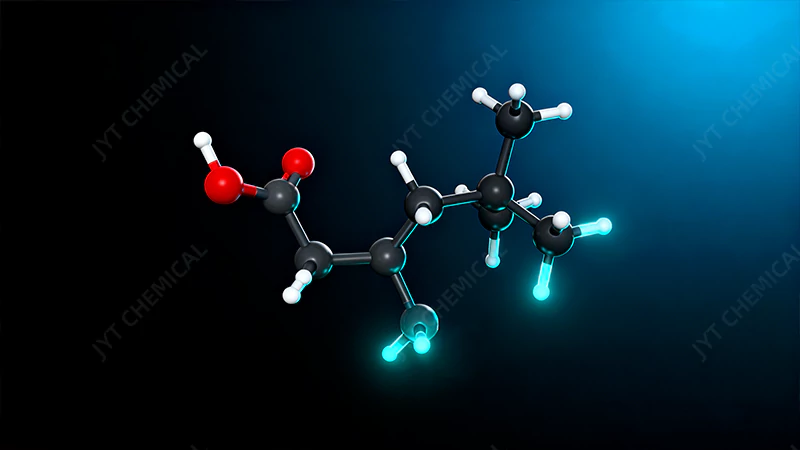
The structure image is an identification aid. It is not evidence that a particular ester or fluid will meet a performance target.
Separate the acid from the finished fluid
In a lubricant ester project, Isononanoic Acid is a reactant. The finished material is an ester made through a selected reaction route and then formulated into a complete fluid. Performance claims for that final fluid cannot be assigned to the acid without supporting formulation and test data.
This distinction helps keep an evaluation focused. Product identity, purity, acid value, color and moisture describe the supplied acid. Viscosity, low temperature behavior, oxidation response, hydrolytic response and equipment compatibility describe the ester or finished fluid. They need separate acceptance criteria.
The same rule applies to coolant and metalworking systems. JYT’s approved data supports use in coolant corrosion inhibitor systems, but it does not establish a universal use level, neutralization route or protection result. Those details depend on the formulation and its validation method.
Build the lubricant ester test plan around the application
The original application should set the test plan. A general purpose industrial lubricant, a metalworking fluid component and a coolant-related fluid do not share the same operating conditions or qualification requirements.
A useful screening plan normally records:
- the intended ester chemistry and target viscosity range;
- the relevant operating temperature range;
- water exposure and hydrolysis test conditions;
- oxidation, volatility and deposit test methods required by the application;
- compatibility requirements for elastomers, metals, coatings and other formulation components;
- the benchmark fluid and pass or fail criteria.
These are evaluation headings, not expected results. If an application has an industry specification or an equipment maker approval process, that requirement should control the test program.
Treat corrosion protection as a formulated property
Isononanoic Acid is listed for coolant corrosion inhibitor systems and metalworking applications. The relevant chemical form must be recorded because the supplied acid and the material evaluated in a finished fluid may not be identical.
A corrosion result should come from the relevant test method, metal set, water quality, concentration, pH and exposure conditions. Visual appearance alone is not enough to compare formulations.
For a water based system, record the complete additive package and test it at the intended dilution. For an ester based system, check both the base fluid and the final additive package. This avoids attributing a result to Isononanoic Acid when another component or a formulation interaction is responsible.
Confirm the supplied grade before formulation work
JYT’s current Isononanoic Acid data lists a minimum purity of 99.5%, a minimum acid value of 350 mg KOH/g, a maximum Pt/Co color of 10 and a maximum moisture content of 0.1 wt%. These are product controls for the JYT grade, not universal values for every material sold under the same name.
Before starting a trial, compare the current technical data with the needs of the reaction or fluid system. Moisture may matter to a water sensitive process. Color may matter to a light colored finished product. Acid value and purity help confirm whether the incoming material matches the grade selected for the project.
Use the TDS for the current product specification, the SDS for handling and hazard communication, and a batch COA for lot specific analytical results. A COA should not be treated as a general product specification.
Use samples to answer the remaining questions
Published product data can establish identity and a starting specification. It cannot confirm application fit. A sample trial should answer the questions that remain:
- Does the material fit the selected reaction and processing conditions?
- Does the ester or derivative meet the target physical properties?
- Does the complete formulation pass the required corrosion, stability and compatibility tests?
- Are results repeatable against the agreed raw material controls?
For an introduction to the material itself, read What is Isononanoic Acid?. The Isononanoic Acid product page provides the current approved product data and request paths for a sample or technical documents.
Reference basis
The compound identity was checked against the PubChem record for 3,5,5-trimethylhexanoic acid. A current manufacturer product data sheet was also reviewed for external confirmation of the stated material identity and its use as an industrial intermediate. Application suitability still requires testing with the selected grade and complete formulation.