Product selection guides
A buyer's checklist for sourcing 2-Ethylhexanoic Acid
How to assess 2-EHA identity, specifications, batch documentation, application qualification, packaging, logistics, and supply terms.

Price matters when sourcing 2-Ethylhexanoic Acid, but it cannot be separated from grade, batch controls, packaging, lead time, and the cost of qualifying a new source. A useful comparison starts with the same technical and commercial requirements for every bidder.
This guide gives procurement and technical teams a review sequence. It does not rank suppliers or treat a manufacturer as preferable to a distributor by default. The aim is to collect evidence, test the offered material, and turn the agreed requirements into purchase and supply terms.
The images in this guide are illustrative. They do not document a JYT Chemical production site, laboratory, capacity, or quality system.
Verify product identity first
2-Ethylhexanoic Acid, commonly shortened to 2-EHA, is a branched C8 carboxylic acid with CAS number 149-57-5 and molecular formula C8H16O2. Approved JYT product data identifies it as an intermediate used for metal carboxylates, synthetic lubricant esters, PVC stabilizers, coatings, and related industrial chemistry.
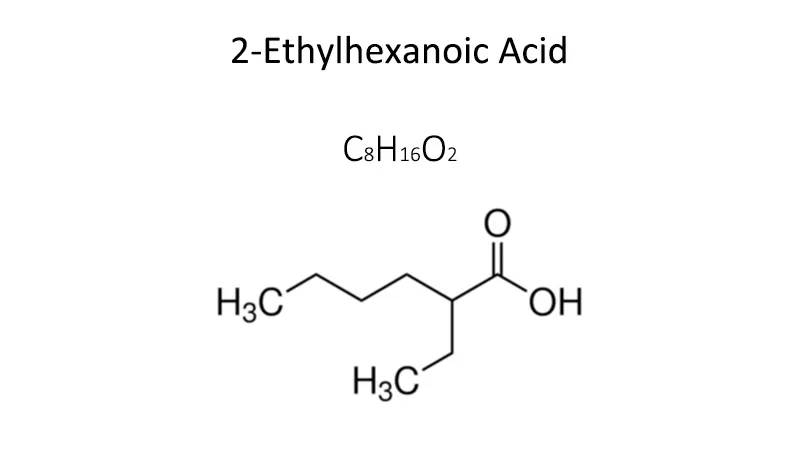
Check that the quotation, specification, SDS, labels, and shipment documents use the same product name and identifier. If the supplier offers more than one grade, record the exact grade code and intended market. A similar trade name is not enough to establish identity.
For the JYT standard grade, the 2-Ethylhexanoic Acid product page lists a minimum purity of 99.5 wt%, a minimum acid value of 385 mg KOH/g, a maximum Pt/Co color of 10, and a maximum moisture content of 0.1 wt%. These values should not be copied to another supplier’s grade. Compare each offer with its current controlled specification and test methods.
Build the technical comparison around evidence
Ask each potential source for the same document set:
- current specification with revision date and grade code;
- test method for each reported property;
- SDS for the product and destination market;
- representative batch-specific certificate of analysis;
- storage and handling guidance;
- packaging specification and label example;
- change-notification procedure.

The certificate of analysis should identify the batch and report the results agreed for release. It is not a general product specification and does not replace your incoming inspection plan. Decide whether the buyer will accept the supplier’s result, perform confirmation testing, or use both.
Review the measurement methods as carefully as the limits. Two specifications can display similar property names while using different conditions or procedures. If the methods are not comparable, the numbers may not support a direct supplier comparison.
Match qualification work to the intended use
2-EHA serves different roles in downstream chemistry. A supplier sample should therefore be tested in the process and end use that matter to the buyer, not only against a generic list of properties.
| Application area | Product role in approved JYT data | Qualification question |
|---|---|---|
| Coatings and resins | Intermediate for metal carboxylate paint driers | Does the candidate source meet the agreed reaction and finished-product criteria? |
| Lubricants and metalworking | Acid intermediate for synthetic lubricant esters and coolant systems | Which process and finished-fluid tests are required for this formulation? |
| PVC and polymer additives | Intermediate used in PVC stabilizers | Does the derived stabilizer meet the processor’s defined acceptance tests? |
These are application contexts, not a performance guarantee. The supplier should not describe a grade as a drop-in replacement unless equivalence has been demonstrated under an agreed test plan.
Before the trial, define the batch size, reference material, process conditions, measurements, and pass criteria. Record any differences, even if both samples meet their individual supplier specifications. The technical team can then decide whether the difference is meaningful for the application.
Examine quality and change management
A supplier assessment should cover the operating process behind the documents. Ask how material is sampled and released, how records are linked to the delivered lot, and how complaints or results outside specification are investigated.
If a supplier cites ISO 9001, confirm the certificate’s legal entity, site, scope, issuer, and validity. ISO describes ISO 9001 as a quality management system standard. Certification may support an organizational review, but it does not certify a 2-EHA grade or guarantee application performance.
Agree in writing which changes require notification. Relevant examples can include a change in manufacturing site, source, process, raw material, analytical method, specification, or packaging. The notification should give the buyer enough time to decide whether documents, samples, or requalification work are needed.
Test the supply proposal, not the sales language
A capacity figure does not show how much material is available for a particular customer. Ask the supplier to respond to a forecast that reflects normal orders, peak demand, destination, and required lead time.
The commercial review should establish:
- normal and maximum order quantities;
- standard lead time and order cut-off;
- quoted Incoterm and validity period;
- allocation policy during restricted supply;
- notification process for delays;
- alternate source or site, if any, and its qualification status;
- price adjustment basis, where applicable.
Do not assume that a diverse sourcing network, a large plant, or a long customer list guarantees continuity. The useful evidence is the supplier’s written commitment for the offered source, volume, route, and period. Critical applications may justify a second qualified source or agreed safety stock, but those measures need their own cost and change-control review.
Confirm packaging, storage, and transport
The approved JYT data lists 900 kg IBC totes and bulk ISO tank supply for 2-Ethylhexanoic Acid. Other producers may list different formats. Confirm the packaging offered for the actual quantity and destination rather than relying on a general brochure.
Packaging review should cover construction material, cleanliness, previous use where relevant, seals, labels, net quantity, and unloading connection. Confirm who owns returnable equipment and who is responsible for cleaning, detention, damage, and disposal.
Storage and transfer requirements must come from the current SDS and product-specific handling information. The OQ 2-EHA handling guide, for example, directs users to review the SDS, keep small containers in a cool, dry, well-ventilated area, protect them from physical damage, and keep containers closed when not in use. Treat that as source-specific guidance and check the instructions supplied with the grade being purchased.
For international orders, document the loading point, route, transit estimate, shipping papers, customs responsibilities, and process for delays or damaged packaging. A quoted arrival date is more useful when the assumptions and responsible parties are visible.
Compare offers with a qualification scorecard
Separate evidence from promises when recording the review.
| Area | Evidence | Decision to record |
|---|---|---|
| Identity and grade | Specification, SDS, labels | Exact material approved |
| Batch release | Methods and representative COA | Incoming test and release plan |
| Application | Sample trial against defined criteria | Approved use and any restrictions |
| Change control | Written notification procedure | Notice period and requalification triggers |
| Supply | Volume, lead time, allocation, source | Approved source and continuity plan |
| Packaging and logistics | Packaging specification and route | Accepted format and delivery responsibilities |
| Support | Named contacts and response path | Owners for technical, quality, and commercial issues |
A low price cannot offset an unidentified grade, an unqualified source, or vague delivery terms. Conversely, a familiar supplier should still be reviewed when the grade, site, packaging, or route changes.
Move from sample to approved source
Close every technical, quality, EHS, and commercial action before approving routine supply. Where appropriate, use a qualification lot to check the received packaging, labels, documents, and batch results against the purchase requirements. Record the approved product, source, application, packaging, and any limitations in the supplier file.
For a JYT evaluation, start with the current 2-Ethylhexanoic Acid technical data. Request the current SDS, TDS, or a batch-specific COA through the controlled document path, and confirm sample and commercial terms for the intended application and destination.